



Reach and impressions won’t save your budget: here’s what will
I’ve yet to meet a CFO who is anti-marketing. But I’ve met plenty who are deeply sceptical of marketers. And the reason is nearly always the same. We keep presenting them with numbers that don’t speak to anything they care about.
Reach. Impressions. Engagement rate. Click-through. These are the metrics that fill marketing reports in organisations across the world. They are easy to produce, easy to present, and almost impossible to challenge, because nobody in the boardroom knows what a good click-through rate looks like, so nobody pushes back. For a while, that feels like safety. It isn’t. It’s a trap.
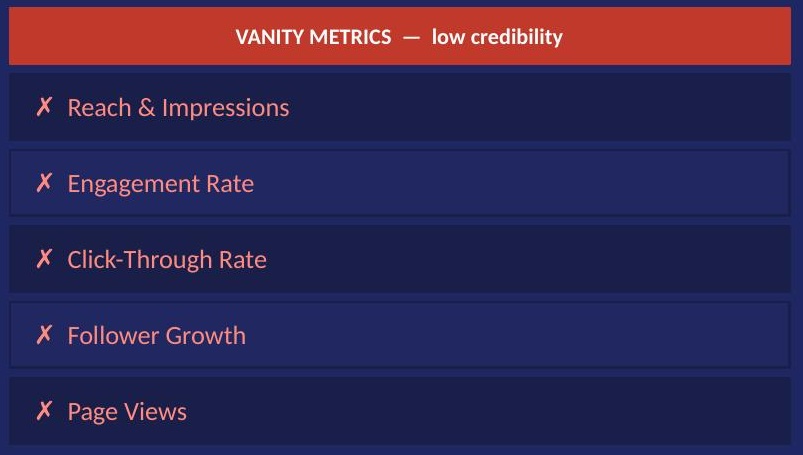
When marketing can’t speak the language of commercial outcomes, it gets treated as a cost. And costs get cut.
This isn’t a new problem, but it’s getting worse. The number of Fortune 500 companies with a CMO or equivalent has fallen by 10 percentage points in just two years. More than a third of CFOs cite the use of vanity metrics as a top concern when evaluating marketing leadership. And the pressure to demonstrate financial impact is increasing, not from one direction but from all of them. CEOs, CFOs, and Boards are all asking the same question with growing impatience: what are we actually getting for our money?
The uncomfortable truth is that marketing created this problem. Not through incompetence, but through habit. Soft metrics are easier to move than hard ones. A campaign that generates 2 million impressions sounds impressive in a way that a campaign that generated 47 new customers simply doesn’t, even though the second number is the one that matters. Over time, we trained our stakeholders to expect the wrong kind of reporting, and then wondered why they didn’t take us seriously.
The shift required isn’t complicated, but it does demand a different kind of discipline.
Every significant marketing initiative should be able to answer three financial questions before it launches. What is the revenue assumption? In other words, if this works, what does it contribute to the top line? What does it cost, fully loaded, including time and resource, not just media spend? And what is the payback period: at what point does the investment break even, and what’s the return beyond that point? If you can’t answer those three questions, the initiative isn’t ready to be approved.
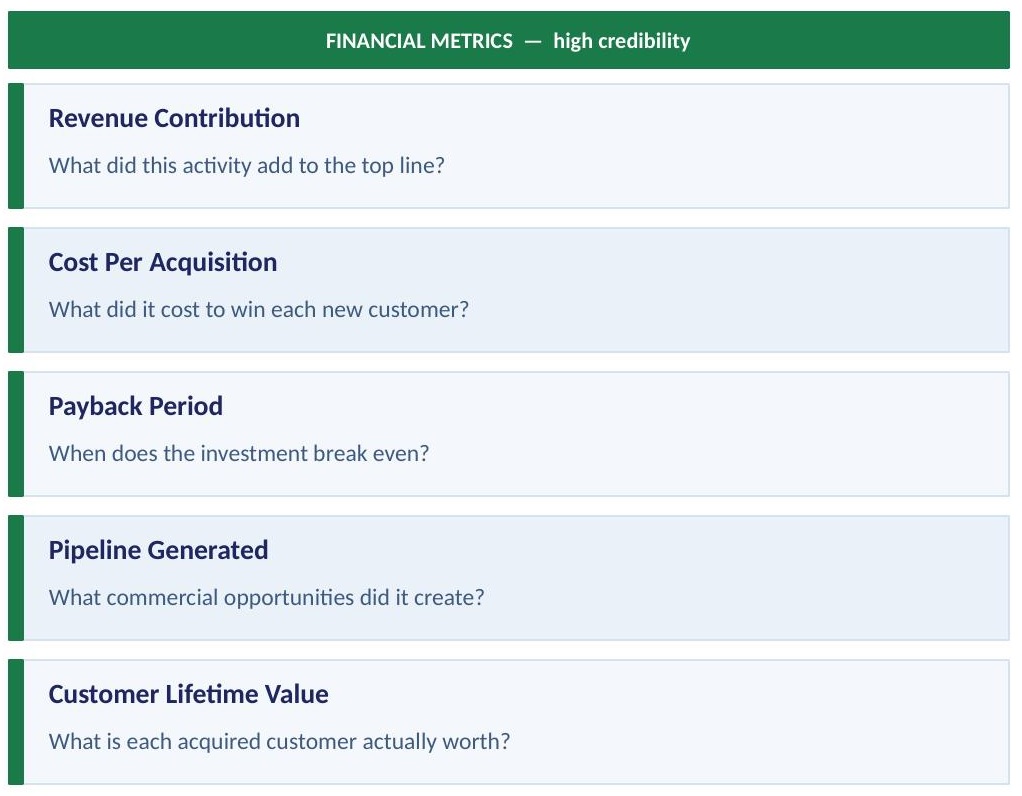
Now, I know the counterargument many will make, brand metrics matter too. Awareness, consideration, and preference are real drivers of long-term commercial value, and they don’t always translate neatly into a revenue figure. That’s true. But there’s a difference between acknowledging that brand investment is hard to measure and using that difficulty as a permanent excuse not to try. The default position should always be financial. Brand and engagement metrics belong in the report, but as supporting evidence (context that helps explain the numbers), not as the headline.
The marketers who thrive in commercial organisations are the ones who have learned to hold both. They understand the funnel deeply enough to connect awareness to revenue, even if that connection involves assumptions that need to be stated and tested over time. They present to the CFO the way a commercial director would: here is the investment, here is the expected return, here is what we will measure to know if it’s working, and here is what we will do if it isn’t.
This is not a complicated ask. But it requires us as marketers to hold ourselves to a standard that soft metrics will never demand of us.
The good news is that the shift in credibility, when it happens, is immediate. Walk into a budget conversation with a model that connects your activity to revenue, and you stop being a cost centre asking for money. You become a growth function making an investment case. Those two conversations feel entirely different, and they lead to entirely different outcomes.
Impressions don’t save budgets. Commercial credibility does.
Citations
1. Forrester: CMO representation in Fortune 500 dropped from 63% to 58%. Forrester, “CMO Fortunes Falter Amid Economic and Role Uncertainty” (August 2025) https://www.forrester.com/blogs/cmo-fortunes-falter-amid-economic-and-role-uncertainty/
2. AdExchanger: 36% of CFOs cite vanity metrics as a top concern. AdExchanger, “How Vanity Metrics Stole Marketing’s Credibility” (July 2025) https://www.adexchanger.com/data-driven-thinking/how-vanity-metrics-stole-marketings-credibility-and-how-cmos-can-get-it-back/
3. The CMO Survey: demonstrating financial impact is the top challenge; pressure from CEOs (61%), CFOs (63%), Boards (50%). The CMO Survey / Duke Fuqua School of Business (Spring 2025) https://cmosurvey.org/marketers-claim-a-broader-role-and-increased-influence-amid-pressures/